Category Archives: Pollution – Plastic

By 2050, the ocean is expected to contain more plastic than fish
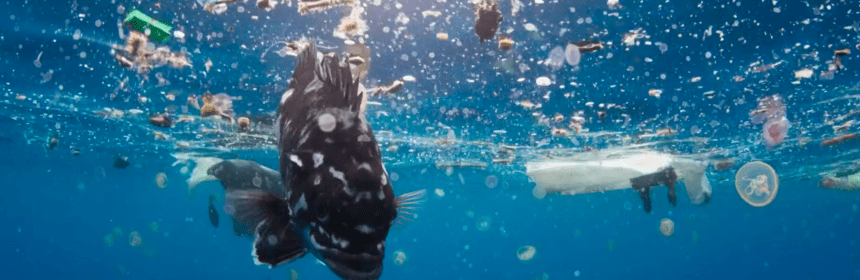
Plastic soup

Plastics and plastic packaging are an integral and important part of the global economy. Plastics production has surged over the past 50 years, from 15 million tonnes in 1964 to 311 million tonnes in 2014, and is expected to double again over the next 20 years, as plastics come to serve increasingly many applications. Plastic packaging, the focus of this report, is and will remain the largest application; currently, packaging represents 26% of the total volume of plastics used. Plastic packaging not only delivers direct economic benefits, but can also contribute to increased levels of resource productivity – for instance, plastic packaging can reduce food waste by extending shelf life and can reduce fuel consumption for transportation by bringing packaging weight down.

While delivering many benefits, the current plastics economy also has important drawbacks that are becoming more apparent by the day. Today, 95% of plastic packaging material value, or $80–120 billion annually, is lost to the economy after a short first use. More than 40 years after the launch of the first universal recycling symbol, only 14% of plastic packaging is collected for recycling. When additional value losses in sorting and reprocessing are factored in, only 5% of material value is retained for a subsequent use. Plastics that do get recycled are mostly recycled into lower-value applications that are not again recyclable after use. The recycling rate for plastics in general is even lower than for plastic packaging, and both are far below the global recycling rates for paper (58%) and iron and steel (70–90%). In addition, plastic packaging is almost exclusively single-use, especially in business-to-consumer applications.

Plastic packaging generates significant negative externalities, conservatively valued by UNEP at $40 billion and expected to increase with strong volume growth in a business-as-usual scenario. Each year, at least 8 million tonnes of plastics leak into the ocean – which
is equivalent to dumping the contents of one garbage truck into the ocean every minute. If no action is taken, this is expected to increase to two per minute by 2030 and four per minute by 2050. Estimates suggest that plastic packaging represents the major share of this leakage. The best research currently available estimates that there are over 150 million tonnes of plastics in the ocean today. In a business-as-usual scenario, the ocean is expected to contain 1 tonne of plastic for every 3 tonnes of fish by 2025, and by 2050, more plastics than fish (by weight).
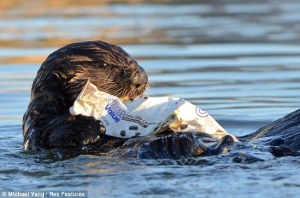
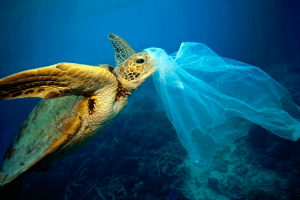
Sea Otter chewing on discarded cookie package; Sea turtle ingesting plastic bag.

The production of plastics draws on fossil feedstocks, with a significant carbon impact that will become even more significant with the projected surge in consumption. Over 90% of plastics produced are derived from virgin fossil feedstocks. This represents, for all plastics (not just plastic packaging), about 6% of global oil consumption, which is equivalent to the oil consumption of the global aviation sector. If the current strong growth of plastics usage continues as expected, the plastics sector will account for 20% of total oil consumption and 15% of the global annual carbon budget by 2050 (this is the budget that must be adhered to in order to achieve the internationally accepted goal to remain below a 2°C increase in global warming).  Even though plastics can bring resource efficiency gains during use, these figures show that it is crucial to address the greenhouse gas impact of plastics production and afteruse treatment.

Plastics often contain a complex blend of chemical substances, of which some raise concerns about potential adverse effects on human health and the environment. While scientific evidence on the exact implications is not always conclusive, especially due to the difficulty of assessing complex long-term exposure and compounding effects, there are sufficient indications that warrant further research and accelerated action.

Many innovations and improvement efforts show potential, but to date these have proved to be too fragmented and uncoordinated to have impact at scale. Today’s plastics economy is highly fragmented. The lack of standards and coordination across the value chain has allowed a proliferation of materials, formats, labelling, collection schemes and sorting and reprocessing systems, which collectively hamper the development of effective markets. Innovation is also fragmented. The development and introduction of new packaging materials and formats across global supply and distribution chains is happening far faster than and is largely disconnected from the development and deployment of corresponding after-use systems and infrastructure. At the same time, hundreds, if not thousands, of small-scale local initiatives are launched each year, focused on areas such as improving collection schemes and installing new sorting and reprocessing technologies. Other issues, such as the fragmented development and adoption of labelling standards, hinder public understanding and create confusion.

In overcoming these drawbacks, an opportunity beckons: using the plastics innovation engine to move the industry into a positive spiral of value capture, stronger economics and better environmental outcomes.

Featured image: Blue Planet II on BBC


SOURCE:

The New Plastics Economy: Rethinking the future of plastics, page 7

World Economic Forum, January 2016


SEE ALSO:  15-Year Study Indicates Huge Increase in Pacific Ocean Microplastics
Seafood eaters ingest up to 11,000 tiny pieces of plastic every year

Seafood eaters ingest up to 11,000 tiny pieces of plastic every year with dozens of particles becoming embedded in tissues, scientists have warned, in findings described as ‘sobering’ by the Prince of Wales.

Researchers from the University of Ghent in Belgium believe that microplastics accumulate in the body over time and could be a long term health risk.

And they say the amount of plastic absorbed will only get worse as pollution in the oceans increases, a finding described by the Prince of Wales as ‘sobering.’  The Prince has previously described micro-particles as ‘grey goo.’

Dr Colin Janssen, who led the research, said the presence of plastic particles in the body was ‘a concern’.

. . . The study is the first comprehensive risk assessment of its kind. Scientists calculated that more than 99 per cent  of the microplastics pass through the human body – but the rest are taken up by body tissues.

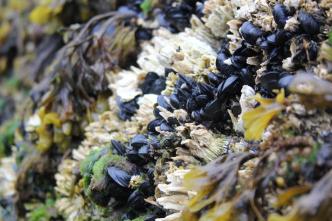
Mussels feed by filtering around 20 litres of seawater a day, ingesting microplastics by accident.

Most are excreted, but on average each mussel contains one tiny fragment lodged in its body tissue. As plastic pollution builds up in the ocean that will increase.

If current trends continue, by the end of the century people who regularly eat seafood could be consuming 780,000 pieces of plastic a year, absorbing 4,000 of them from their digestive systems.

A person eats mussels and French fries during the annual Braderie de Lille (Lille Fleamarket) on September 1, 2012 in Lille, northern France. At least two million visitors are expected over the weekend at the Braderie, one of Europe's largest fleamarket, gathering about ten thousands professional salesmen and Lille residents who want to sell or exchange their unwanted good. AFP PHOTO PHILIPPE HUGUEN (Photo credit should read PHILIPPE HUGUEN/AFP/GettyImages)  mussel-rock

Microplastics are widely found in mussels, oysters and other shellfish, Left photo credit Phillippe Huguen/AFP/GettyImages

. . . There are more than five trillion pieces of microplastic in the world’s oceans and the equivalent of one rubbish truck of plastic waste is being added to the sea every minute.

By 2050 that will increase to four trucks every minute. The plastic in the ocean will take decades or even centuries to break down into small pieces, but many scientists believe it will never completely disappear.

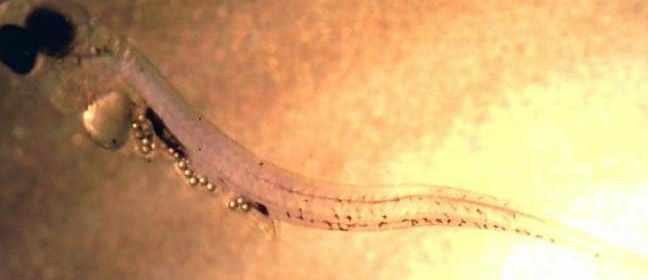
Featured Image: A larval perch that has ingested microplastic particles, Credit: Oona Lonnstedt  

SEE FULL ARTICLE AT:

Seafood eaters ingest up to 11,000 tiny pieces of plastic every year, study shows 

By Sarah Knapton, science editor, The Telegraph

24 January 2017

http://www.telegraph.co.uk/science/2017/01/24/seafood-eaters-ingest-11000-tiny-pieces-plastic-every-year-study/


Sperm Whales Found Full of Car Parts and Plastics

Fishing gear and an engine cover are just some of the startling contents found inside the stomachs of sperm whales that recently beached themselves on Germany’s North Sea coast.

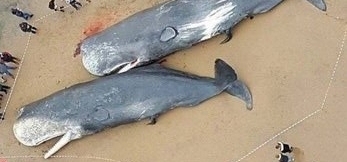
The 13 sperm whales washed up near the German state of Schleswig-Holstein earlier this year, the latest in a series of whale strandings around the North Sea. So far, more than 30 sperm whales have been found beached since the start of the year in the U.K., the Netherlands, France, Denmark, and Germany.

After a necropsy of the whales in Germany, researchers found that four of the giant marine animals had large amounts of plastic waste in their stomachs. The garbage included a nearly 43-foot-long (13-meter-long) shrimp fishing net, a plastic car engine cover, and the remains of a plastic bucket, according to a press release from Wadden Sea National Park in Schleswig-Holstein.

However, “the marine litter did not directly cause the stranding,” says Ursula Siebert, head of the Institute for Terrestrial and Aquatic Wildlife Research at the University of Veterinary Medicine Hannover, whose team examined the sperm whales.

Instead, the researchers suspect that the whales died because the animals accidentally ventured into shallow seas.

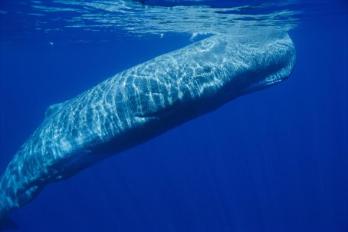
Sperm whale swims near the Azores in the Atlantic Ocean. Photography by Brian Skerry, National Geographic Creative

. . . According to the WDC, whales and dolphins may strand for many reasons, such as excessive noise pollution from ships and drilling surveys or even subtle shifts in Earth’s magnetic field. In addition, pilot whales that beached off the coast of Scotland three years ago showed high levels of toxins from ocean pollution, which scientists linked to stress on their brains that may have caused disorientation.

Schleswig-Holstein environment minister Robert Habeck holds debris found inside beached sperm whales in a picture posted to Instagram.  (Photo Robert Habeck,Instagram)

. . . Siebert adds that if the whales had survived, the garbage in their guts might have caused digestive problems down the line. At the time of death, the animals were in decent shape and, in addition to the debris, the scientists found thousands of squid beaks in the whales’ stomachs.

But when whales and dolphins ingest lots of marine litter, either accidentally or because they mistake the trash for prey, it can cause physical damage to their digestive systems. The trash may eventually give the animals the sensation of being full and reduce their instinct to feed, leading to malnutrition.

While the garbage may not have been lethal for these whales, “the plastic debris in their stomachs is a horrible indictment of humans,” adds Hal Whitehead, a whale researcher at Dalhousie University in Nova Scotia, Canada.

READ FULL ARTICLE AT:

Sperm Whales Found Full of Car Parts and Plastic

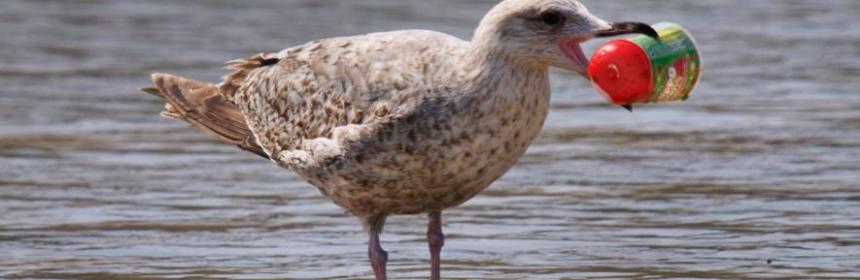
Nearly Every Seabird on Earth Is Eating Plastic

Plastic trash is found in 90 percent of seabirds. The rate is growing steadily as global production of plastics increases.

“That was shocking,” says Chris Wilcox, a research scientist with Australia’s Commonwealth Scientific and Industrial Research Organization and lead author of the study. “Essentially, the number of species and number of individuals within species that you find plastic in is going up fairly rapidly by a couple percent every year.”

The most disturbing finding, Wilcox says, is the link between the increasing rate of plastics manufacturing and the increasing rate at which the material is saturating seabirds.

“Global plastic production doubles every 11 years,” Wilcox says. “So in the next 11 years, we’ll make as much plastic as we’ve made since plastic was invented. Seabirds’ ingestion of plastic is tracking with that.”

ingestion-black-footed-albatross-ingesting-plastic-3-photo-frans-lanting  ingestion-albatross-fledgling-chris-jordan  ingestion-bird-snacking-on-cigarette-butt-photo-credit-lea-anne-stacy-on-pinterst

Black-footed albatross ingesting plastic Photo: Frans Lanting; Albatross fledgling Photo: Chris Jordan; Bird ingesting cigarette butt

… are more prone to eating plastic because they fish by skimming their beaks across the top of the water, and inadvertently take in plastics floating on the surface. Petrels and shearwaters, which live on offshore islands and forage over large areas of sea, also contain large amounts of plastic in their stomachs.

Plastic found inside birds includes bags, bottle caps, synthetic fibers from clothing, and tiny rice-sized bits that have been broken down by the sun and waves.

The health effects of plastics on seabird populations have not been fully measured. But observational data collected is troubling enough, Wilcox says.

Sharp-edged plastic kills birds by punching holes in internal organs. Some seabirds eat so much plastic, there is little room left in their gut for food, which affects their body weight, jeopardizing their health. One bird examined by scientist Denise Hardesty had consumed 200 pieces of plastic.

“If you add more plastic to the gut, it will eventually make a difference,” Wilcox says. “The trend suggests that it’s going to keep increasing.”

A recent study found a 67 percent decline in seabird populations between 1950 and 2010.

READ FULL ARTICLE:

Nearly Every Seabird on Earth Is Eating Plastic

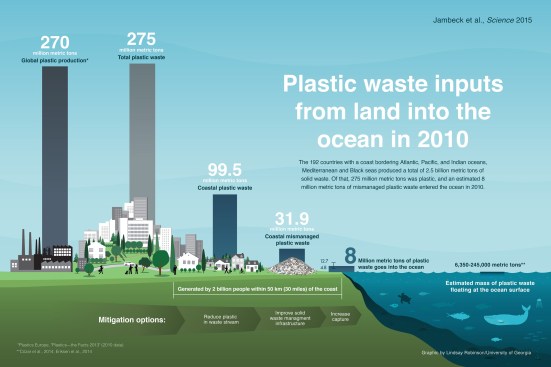
8 million metric tons of plastic are going from the land into the oceans each year

In a 2015 study, researchers calculated that 8 MILLION METRIC TONS OF PLASTIC ARE ENTERING THE OCEANS EVERY YEAR from 6.4 billion people living in 192 coastal countries (93% of the global population).THAT’S OVER 21,000 TONS PER DAY! 8 million metric tons of plastic is equal to 16 grocery bags filled with plastic going into the ocean along every metre of coastline in the world (or five grocery bags per foot of coastline).

On our current trajectory, by 2025, this amount could double!

Major contributors are middle income countries with rapidly growing economies that have not developed sufficient waste management systems.

infographic

The 192 countries with a coast bordering the Atlantic, Pacific and Indian oceans, Mediterranean and Black seas produced a total of 2.5 billion metric tons of solid waste. Of that, 275 million metric tons was plastic, and an estimated 8 million metric tons of mismanaged plastic waste entered the ocean in 2010. Credit: Lindsay Robinson/UGA

READ FULL ARTICLE:

Magnitude of plastic waste going into the ocean calculated: 8 million metric tons of plastic enter the oceans per year

February 12, 2015, University of Georgia

Summary: How much mismanaged plastic waste is making its way from land to ocean has been a decades-long guessing game. Now scientists have put a number on the global problem. Their study found between 4.8 and 12.7 million metric tons of plastic entered the ocean in 2010 from people living within 50 kilometers of the coastline.

A plastic grocery bag cartwheels down the beach until a gust of wind spins it into the ocean. In 192 coastal countries, this scenario plays out over and over again as discarded beverage bottles, food wrappers, toys and other bits of plastic make their way from estuaries, seashores and uncontrolled landfills to settle in the world’s seas.

How much mismanaged plastic waste is making its way from land to ocean has been a decades-long guessing game. Now, the University of Georgia’s Jenna Jambeck and her colleagues in the National Center for Ecological Analysis and Synthesis working group have put a number on the global problem.

Their study, reported in the Feb. 13 edition of the journal Science, found between 4.8 and 12.7 million metric tons of plastic entered the ocean in 2010 from people living within 50 kilometers of the coastline. That year, a total of 275 million metric tons of plastic waste was generated in those 192 coastal countries.

Jambeck, an assistant professor of environmental engineering in the UGA College of Engineering and the study’s lead author, explains the amount of plastic moving from land to ocean each year using 8 million metric tons as the midpoint: “Eight million metric tons is the equivalent to finding five grocery bags full of plastic on every foot of coastline in the 192 countries we examined.”

To determine the amount of plastic going into the ocean, Jambeck “started it off beautifully with a very grand model of all sources of marine debris,” said study co-author Roland Geyer, an associate professor with the University of California, Santa Barbara’s Bren School of Environmental Science & Management, who teamed with Jambeck and others to develop the estimates.

They began by looking at all debris entering the ocean from land, sea and other pathways. Their goal was to develop models for each of these sources. After gathering rough estimates, “it fairly quickly emerged that the mismanaged waste and solid waste dispersed was the biggest contributor of all of them,” he said. From there, they focused on plastic.

“For the first time, we’re estimating the amount of plastic that enters the oceans in a given year,” said study co-author Kara Lavender Law, a research professor at the Massachusetts-based Sea Education Association. “Nobody has had a good sense of the size of that problem until now.”

The framework the researchers developed isn’t limited to calculating plastic inputs into the ocean.

“Jenna created a framework to analyze solid waste streams in countries around the world that can easily be adapted by anyone who is interested,” she said. “Plus, it can be used to generate possible solution strategies.”

Plastic pollution in the ocean was first reported in the scientific literature in the early 1970s. In the 40 years since, there were no rigorous estimates of the amount and origin of plastic debris making its way into the marine environment until Jambeck’s current study.

Part of the issue is that plastic is a relatively new problem coupled with a relatively new waste solution. Plastic first appeared on the consumer market in the 1930s and ’40s. Waste management didn’t start developing its current infrastructure in the U.S., Europe and parts of Asia until the mid-1970s. Prior to that time, trash was dumped in unstructured landfills–Jambeck has vivid memories of growing up in rural Minnesota, dropping her family’s garbage off at a small dump and watching bears wander through furniture, tires and debris as they looked for food.

“It is incredible how far we have come in environmental engineering, advancing recycling and waste management systems to protect human health and the environment, in a relatively short amount of time,” she said. “However, these protections are unfortunately not available equally throughout the world.”

Some of the 192 countries included in the model have no formal waste management systems, Jambeck said. Solid waste management is typically one of the last urban environmental engineering infrastructure components to be addressed during a country’s development. Clean water and sewage treatment often come first.

“The human impact from not having clean drinking water is acute, with sewage treatment often coming next,” she said. “Those first two needs are addressed before solid waste, because waste doesn’t seem to have any immediate threat to humans. And then solid waste piles up in streets and yards and it’s the thing that gets forgotten for a while.”

As the gross national income increases in these countries, so does the use of plastic. In 2013, the most current numbers available, global plastic resin production reached 299 million tons, a 647 percent increase over numbers recorded in 1975. Plastic resin is used to make many one-use items like wrappers, beverage bottles and plastic bags.

With the mass increase in plastic production, the idea that waste can be contained in a few-acre landfill or dealt with later is no longer viable. That was the mindset before the onslaught of plastic, when most people piled their waste–glass, food scraps, broken pottery–on a corner of their land or burned or buried it. Now, the average American generates about 5 pounds of trash per day with 13% of that being plastic.

But knowing how much plastic is going into the ocean is just one part of the puzzle, Jambeck said. With between 4.8 and 12.7 million metric tons going in, researchers like Law are only finding between 6,350 and 245,000 metric tons floating on the ocean’s surface.

“This paper gives us a sense of just how much we’re missing,” Law said, “how much we need to find in the ocean to get to the total. Right now, we’re mainly collecting numbers on plastic that floats. There is a lot of plastic sitting on the bottom of the ocean and on beaches worldwide.”

Jambeck forecasts that the cumulative impact to the oceans will equal 155 million metric tons by 2025. The planet is not predicted to reach global “peak waste” before 2100, according to World Bank calculations.

“We’re being overwhelmed by our waste,” she said. “But our framework allows us to also examine mitigation strategies like improving global solid waste management and reducing plastic in the waste stream. Potential solutions will need to coordinate local and global efforts.”

Story Source:

The above post is reprinted from materials provided by University of Georgia. The original item was written by Stephanie Schupska. Note: Materials may be edited for content and length.

Journal Reference:

R. Jambeck, R. Geyer, C. Wilcox, T. R. Siegler, M. Perryman, A. Andrady, R. Narayan, K. L. Law. Plastic waste inputs from land into the oceanScience, 2015; 347 (6223): 768 DOI:10.1126/science.1260352

Cite this page:

University of Georgia. “Magnitude of plastic waste going into the ocean calculated: 8 million metric tons of plastic enter the oceans per year.” ScienceDaily. ScienceDaily, 12 February 2015.
https://www.sciencedaily.com/releases/2015/02/150212154422.htm

Study:

Plastic waste inputs from land into the ocean

Jenna R. Jambeck,Roland Geyer,2 Chris Wilcox,3 Theodore R. Siegler,4 Miriam Perryman,1 Anthony Andrady,5 Ramani Narayan,6 Kara Lavender Law7

Click to access Science-2015-Jambeck-768-71__2_.pdf


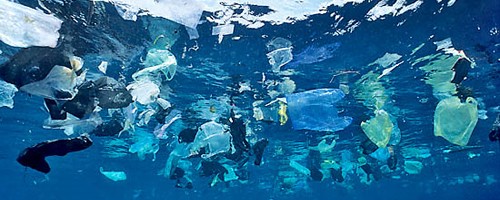
More than 5 Trillion Plastic Pieces Afloat at Sea

In a 2014 study, it was estimated that AT LEAST 5.25 TRILLION PLASTIC PARTICLES, WEIGHING 269,000 METRIC TONS ARE CURRENTLY FLOATING AT SEA and that:

  • 92% is comprised of small fragments (0.33-4.75 mm).
  • Of larger items (>200mm), foamed polystyrene items were the most frequently observed.
  • During fragmentation plastics are lost from the sea surface.

This does not include the massive amount of plastic that sinks (extremely difficult to determine because of the huge depths of the ocean), washes up on beaches and seashores, or has been ingested by organisms.


READ FULL ARTICLE:

Weighing over 5 Trillion Pieces of Ocean Trash Found, But Fewer Particles Than Expected

 Scientists estimate extent of plastic pollution amid mystery of where it’s all going.
Recent Entries »